
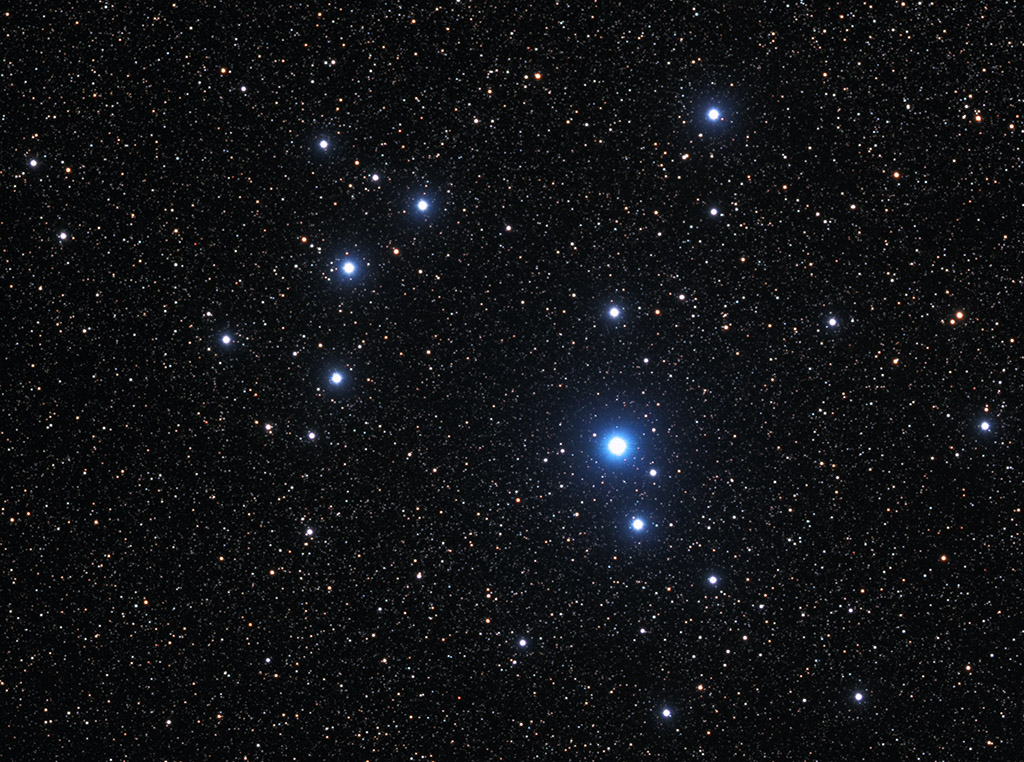
Location: Warrumbungle Observatory, Australia (149 11 E, 31 16 S)
Date: 19 and 20 May 2013
Camera: QHY-9 and QHY filters
Telescope: William Optics M120
Frames: Twelve 10 minute luminance frames and eleven 300 second exposures for each of RGB.
Processing: Stacked in CCDStack, balanced, curves, highlights and increased colour in Photoshop SC5.
Text adapter from Wikipedia: IC 2602, also known as the Theta Carinae Cluster or Southern Pleiades, is an open cluster in the constellation Carina. It was discovered by Abbe Lacaille in 1751 from South Africa. The cluster is at a distance of about 479 light-years away from Earth and can be seen with the naked eye. The Southern Pleiades (IC 2602) has an overall apparent magnitude of 1.9, which is 70% fainter than the Taurean Pleiades, and contains about 60 stars. Theta Carinae, the brightest star within the open cluster, is a third-magnitude star with an apparent magnitude of +2.74. All the other stars within the cluster are of the fifth magnitude and fainter. Like its northern counterpart in Taurus, the Southern Pleiades spans a sizeable area of sky, so is best viewed with large binoculars or telescope with a wide-angle eyepiece. The cluster is beleived to be 50 million years old.
